
rediffGURU Chocko Valliappa counsels students how to choose the right course and career after Class 12.

The National Pharmaceutical Pricing Authority will monitor how companies are increasing prices of non-scheduled drugs.

Two former employees of a Delhi-based pharmaceutical firm have been booked for allegedly cheating, forging documents and impersonating to secure government tenders, including supplies to Army hospitals.

New lower GST rates kicked in from Monday, resulting in a slashing of prices of as many as 375 items ranging from toothpaste and shampoo to cars and television sets, a move seen as an attempt to boost consumption to cushion an economy facing tariff headwinds. Tax rates of 5, 12, 18, and 28 per cent have been clubbed into two rates of 5 per cent and 18 per cent, resulting in a reduced price of 99 per cent of daily use items.
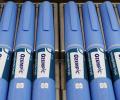
The fast-growing GLP-1 market, propelled by lower-cost generics following patent expiry, is widening availability beyond patients with obesity and diabetes -- but also driving unsupervised, appearance-led demand, according to doctors.

The amazing story of how a little known cheese from Ladakh stunned the world!
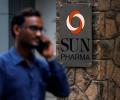
Sun Pharmaceutical Industries' acquisition of US-based Organon & Co. for $11.75 billion, the largest overseas acquisition by an Indian pharma company, has been met with mixed reactions from brokerages, who see strategic entry into women's health and biosimilars but also flag potential integration challenges and debt concerns.

Inspections conducted across 49 entities including pharmacies, wholesalers, and clinics to detect violations and misleading marketing practices.
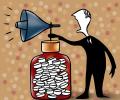
For decades, multinational pharmaceutical companies and Indian drugmakers worked in ways that supported each other: MNCs brought innovation and brands, while Indian companies built scale through generics and cost efficiency. There was an important overlap - generic drugs - but this is shrinking fast. And the consequences are reshaping India's gigantic pharmaceutical market.

At the heart of this debate is Section 3(d) of the Patents Act, a safeguard designed to prevent drugmakers from extending monopoly protection through trivial modifications to existing medicines.

While the introduction of branded generics is likely to accelerate volumes for GLP-1 agonists, value growth may moderate because of price erosion.
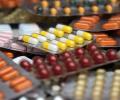
India's pharmaceutical exports have shown robust growth, reaching over USD 28 billion, despite global economic challenges. The sector is projected to reach USD 130 billion by 2030.
'At the first sign of real trouble, that money will move. There will be a run.'

For patients, the immediate impact is a reduction in the final cost of therapies that often run into lakhs per month.
The European Union's (EU's) offer to slash tariffs on 97.5 per cent of Indian chemical exports to zero is set to give India's pharmaceutical and medical device firms preferential access to the European markets.

Iran is fighting a different war: Older, slower, and in some ways more dangerous. Iran doesn't need to shoot down an F/A-18. It only needs to make the Strait of Hormuz feel dangerous long enough for insurance markets, shipping companies, and oil futures traders to do the rest. Prem Panicker continues his must-read daily blog on the war in the Middle East.

US President Donald Trump's plan to sign an executive order to cut prescription drug prices by 30-80 per cent could lead to a global price adjustment with pharma firms pushing lower-cost countries like India to raise prices, according to the economic think tank GTRI. The US move could push prices in lower-cost countries like India as manufacturers would seek to recover losses and R&D costs from these nations.

Domestic pharma companies have warned that the Patent Bill in its original form could lead to ever-greening of patents and rise in prices of drugs.
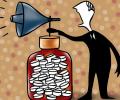
US accounts for a large part of revenue for top Indian pharma companies like Gland Pharma (54 percent), Dr Reddy's (53 per cent), and Aurobindo Pharma (48 per cent).

What we are watching is something different: A fog manufactured and maintained by the people who started the war, so that the question of why it was started never has to be answered, observes Prem Panicker in his must read blog on the war in the Middle East.

The government has been stringent with pricing changes. Prices of 651 essential medicines came down from April 1, 2023 by 6.73 per cent with the government capping ceiling prices of these drugs.

Emcure Pharmaceuticals on Monday said it saw Poviztra, its newly launched semaglutide brand, as a "long-term" opportunity in India's fast-evolving obesity and cardiometabolic therapy market, even as price competition in the glucagon-like peptide-1 (GLP-1) segment intensified.
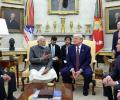
'No retaliatory tariffs now. You can retaliate after a few months.' 'Today, there is no need to retaliate because it is a question of long term benefits.'

'We need to give Pakistan something serious to think about on its eastern front -- that is the only way to actually help Afghanistan right now.'

The Union Budget for 2026-27, presented by Finance Minister (FM) Nirmala Sitharaman on Sunday, which was a first, had an excellent domestic macro backdrop. According to the first advance estimates, gross domestic product (GDP) in constant prices is projected to grow 7.4 per cent in the current financial year, against 6.5 per cent in 2024-25.

Gross GST collection rose 9.1 per cent to over Rs 1.89 lakh crore in September on the back of increased sales due to rate rationalisation, as per government data released on Wednesday.
The National Pharmaceutical Pricing Authority has revised prices of 440 medicines. Around 300 medicines have seen price cuts, while the others have seen a hike, sources said. The extent of the revisions is not known as yet.
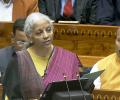
Budget 2026 sticks to fiscal discipline, shuns populist measures despite five key state elections coming up, but ends up rattling stock markets with a higher transaction tax on derivatives trading.
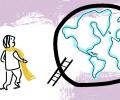
The recipe for Indian higher education institutions to succeed in the global markets is excellence in academics, promoting contemporary socially relevant material, and enabling individuals (learners) to realise their full potential, suggests N Ravichandran.

Three persons, including the shop owner, have been arrested for the attack that took place in the Rawatpur area around 9 pm on Saturday. A search is underway for a fourth accused, they said.
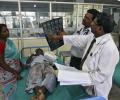
The rationalisation of goods and services tax (GST), announced on Wednesday, directly lowers the cost of everyday medical consumables, and also high-end therapies in oncology and rare diseases, helping reduce out-of-pocket patient expenditure and better adherence to medication.

The decision to hike US H-1B visa application fee to $100,000, trade talks and the GST rate cut will be the key drivers for stock market movement this week, analysts said.

Indian drugmakers Eris Lifesciences, Wockhardt and Lupin are prepping to cash in when Danish company Novo Nordisk bows out of the human insulin pen market by the end of this year and creates an opportunity estimated to be worth Rs 600-800 crore in the domestic market. Some self-use disposable pens are pre-filled with insulin and others can be reused with new cartridges.
As per the new guidelines, the wholesalers will get 15 per cent margin while retailers will 35 per cent over the cost of manufacturing of generic medicines, Minister of Chemicals and Fertiliser Ram Vilas Paswan told reporters.
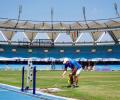
The iconic Jawahar Lal Nehru Stadium in New Delhi will be "dismantled" to create a Sports City that will cater to all major disciplines and include lodging facility for athletes.

The bumper rise is due to the rising demand for the drug and patients' gradual shift towards its higher dosage.

For the consumer, there would be practically no impact on prices of essential medicines this year.

The US Food and Drug Administration's (USFDA)'s new draft guidelines aimed at speeding up and reducing the cost of developing biosimilars - lower-priced, near-replicas of complex biologic medicines - could significantly benefit Indian biotech companies.
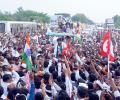
'Our politics is transparent -- it's about ensuring farmers don't die by suicide, about ensuring agriculture remains viable, about ensuring food security for the nation.' 'If that's politics, then yes, we do politics.'

The Maoists in Bastar went from one village to another with kits providing badly needed medical intervention. The medical help was one key reason why the tribals were attracted to the Maoists, points out M R Narayan Swamy.
